Why are marketers suddenly throwing AIEO, GEO, and AEO at you?
If you’re a local business owner, you’ve probably noticed a shift in the way agencies talk.
Ten years ago, everyone sold you “SEO.”
Now you’re hearing about AIEO, GEO, and AEO.
It’s not just one vendor either. One talks about AI Engine Optimization, another pushes Answer Engine Optimization, and someone else promises Generative Engine Optimization.
If this feels like alphabet soup, you’re not wrong.
If you want the bigger picture on why this shift is happening, we broke it down in plain English here.
From where I sit, as a technical director who spends more time than I’d like untangling the impact of buzzwords, it looks like this:
- Search is changing. People don’t just type into Google anymore, they ask AI assistants, talk to their phones and cars, and rely on maps and review sites.
- Vendors are racing to rebrand. A lot of what’s being sold under new acronyms is still foundational SEO and local SEO work, just wrapped in fresher packaging.
The good news, you don’t need to become an acronym expert.
But you do need to understand, in plain language, what these terms point to, so you can tell the difference between a real system and a shiny sales pitch.
Let’s decode each one.
What is AIEO (AI Engine Optimization) in plain business terms?
Think of AIEO as SEO updated for a world where your customers don’t always start with a classic Google results page.
Instead, they:
- ask ChatGPT for “the best electrician near me,”
- use Gemini or Copilot to research “how much does a fence cost in [your city],”
- talk to their car’s assistant about “closest reputable HVAC company,”
- or ask Siri to “find a plumber who’s open right now.”
All of those tools are using some kind of AI system to decide what to show or recommend.
In plain business terms:
AIEO, AI Engine Optimization, is the practice of making your business understandable, trustworthy, and easy to recommend for AI-driven tools and assistants.
This overlaps with what many platforms describe as AI-driven discovery and answer surfaces. The labels vary, but the practical work is similar, you want your content and business data to be clear and machine-readable, which is why Google emphasizes the basics of how structured data works in the first place.
What does AIEO look like for a local business?
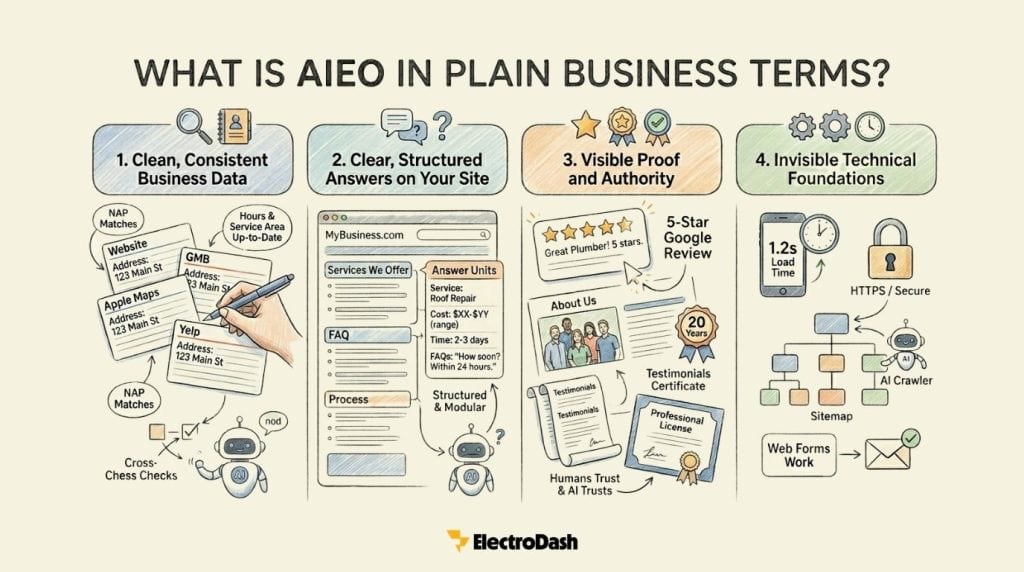
Done well, it focuses on four big buckets:
- Clean, consistent business data
- Your name, address, phone number, and website match across your website, Google Business Profile, Apple Maps, Yelp, and major directories.
- Your hours, service area, and core services are accurate and up to date.
- AI systems cross-check your information across the web, inconsistencies make you look less trustworthy.
- Clear, structured answers on your site
- Your service pages actually answer questions like:
- What do you charge, even as a range?
- How long does this take?
- What is included and what is not?
- Pages include FAQs that address common “how,” “what,” and “when” questions.
- You structure that information in ways AI systems can easily parse, often using schema markup, FAQ, HowTo, LocalBusiness, and so on.
- Your service pages actually answer questions like:
- Visible proof and authority
- Real reviews on your Google Business Profile and other key platforms.
- Basic about information, who you are, years in business, certifications, licenses, service area.
- Clear, verifiable claims, backed by photos, case studies, or testimonials.
- Technical foundations that don’t get in the way
- Pages load quickly and work on mobile devices.
- Your site is secure, not riddled with errors, and easily crawlable.
- Forms actually deliver email, so leads don’t disappear into a black hole.
If your website is outdated or unreliable, the smartest “AI optimization” in the world won’t stick. That’s why we treat your website as core infrastructure, and why a solid website foundation matters before you try to win new search surfaces.
From an AI engine’s perspective, AIEO answers questions like:
- Is this business real?
- Do multiple sources agree on its details?
- Is this content reliable enough to quote?
- Will a customer have a good experience if we point them here?
That’s the heart of AIEO.
What is AEO (Answer Engine Optimization), and how is it different from AIEO?
AEO stands for Answer Engine Optimization.
The idea is simple:
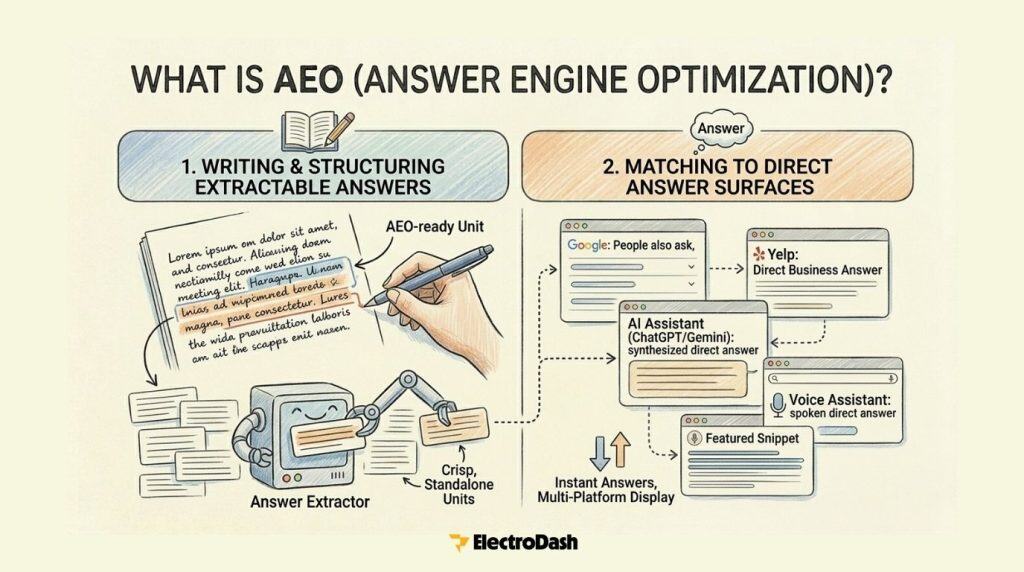
AEO is about writing and structuring content so that systems built to give direct answers, rather than just lists of links, can easily grab and use your information.
Answer engines show up as:
- People also ask boxes in Google
- Featured snippets (“Position Zero”)
- Direct answers read out by voice assistants
- Short Q and A responses in AI chat tools
This is why Answer Engine Optimization best practices lean so heavily on crisp page structure, scannable formatting, and content that answers real questions fast.
AEO focuses on answerable units, small, clear, self-contained answers that can be dropped straight into those experiences.
AEO vs. AIEO: how are they related?
The key difference:
- AEO is about extractable answers
- AIEO is about overall AI understanding and trust
You can think of it this way:
AEO is a subset of AIEO. Great AIEO usually includes good AEO, but not every AEO effort handles the broader technical and trust foundations AIEO requires.
Example: One paragraph, AEO-style
Let’s say you’re a local fence company. Here’s a typical, vague paragraph:
We offer high-quality fence installations at competitive prices with excellent service and fast turnaround.
An AEO-style answer block looks more like this:
How much does a fence cost in [Your City]?
In [Your City], most homeowners spend between $3,000 and $8,000 on a new fence, depending on the material and length. Wood fences usually start around $30 per linear foot installed, while vinyl typically starts closer to $40 per linear foot. We provide free in-person estimates so you know exactly what your project will cost before we start.
Notice what changed:
- It answers a specific question clearly.
- It includes numbers and context, not just adjectives.
- It’s written as a standalone answer that an assistant or answer surface could quote.
That’s AEO in practice.
What do people mean by GEO (Generative Engine Optimization)?
GEO is most commonly used today to mean Generative Engine Optimization.
Traditional SEO was built around search engines that show lists of links. GEO shifts the focus to generative engines, AI systems that build full, synthesized answers from multiple sources.
Think:
- Google’s AI Overviews
- AI chat tools like ChatGPT, Gemini, Copilot, and Perplexity
- In-app assistants that answer questions or recommend providers
These tools don’t just rank you. They read, evaluate, and then write an answer that may or may not include your business as a cited source.
In plain business terms:
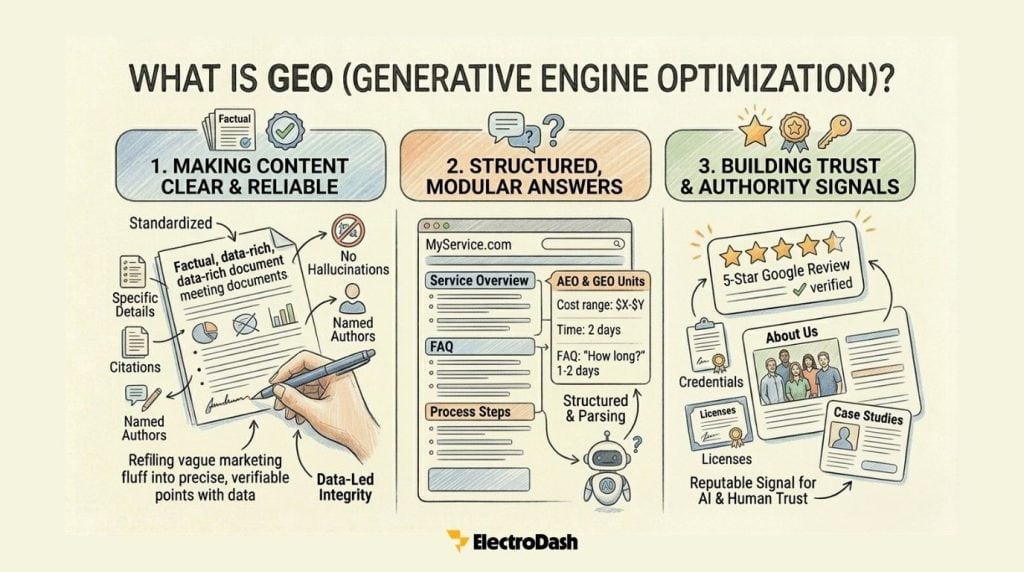
GEO, Generative Engine Optimization, is about making your content clear, reliable, and structured enough that generative AI systems feel safe using it in their answers.
SEMrush’s overview of Generative Engine Optimization (GEO) is a useful way to understand the shift, you’re no longer only competing for clicks, you’re competing to be included in the answer.
Where Google fits into GEO
Because Google is such a major player, a lot of GEO conversations revolve around Google’s generative experiences, especially AI Overviews and how they appear in search results.
But the concept itself is broader:
- You want to be part of the answer when AI tools talk about your services, your city, and your category, not just when someone types a keyword into Google.
- That includes Google AI Overviews, plus ChatGPT, Gemini, Copilot, and other generative experiences inside apps and vertical platforms.
What does GEO actually involve?
In practice, effective GEO overlaps heavily with AIEO and AEO:
- Clear, verifiable facts
- Structured, modular content
- Strong trust and authority signals
- Technical readiness
If you’re a local business, the “Get Found” part is not just about ranking anymore. It is about being present and consistent across the places AI systems pull from, including maps and listings. That’s why our Get Found work is designed around visibility plus accuracy, not vanity metrics.
So if AIEO looks at “How do all AI engines understand and evaluate my business?”, then GEO refines the question to:
“When a generative engine builds a complete answer, does my content make the cut to be part of that answer, or cited under it?”
For a local business owner, the takeaway is straightforward:
If your information is accurate, your answers are clear, and your proof is visible, you’re already doing the important parts of GEO, even if you never say “Generative Engine Optimization” out loud.
How marketers actually use these terms (and how to decode the pitch)
Now for the uncomfortable part, in practice, not everyone uses these acronyms carefully.
Here’s how to translate what you’re told into what’s actually being done.
When someone sells you “AIEO”
Ideally, they mean they’ll help you:
- Clean up your business data across the web
- Improve your site structure and content so AI systems can parse and trust it
- Add structured data so information is machine-readable
- Strengthen your proof, reviews, testimonials, author info, credentials
- Fix technical issues that block crawling, indexing, or usability
If all you hear is “We’ll sprinkle AI keywords around your pages,” that’s not AIEO. That’s just SEO with extra jargon.
When someone sells you “AEO”
They should be focused on:
- Building FAQ sections that answer real questions clearly
- Creating short, definition-style explanations on key pages
- Structuring content so it’s easy to pull into featured snippets, People also ask, and voice answers
If what they’re showing you is just a standard blog with long paragraphs and no Q and A structure, that’s not really AEO either, regardless of what they call it. HubSpot’s AEO guidance is a decent gut check for what “answer-ready” content should look like in practice.
When someone sells you “GEO”
If they’re using GEO in the Generative Engine Optimization sense, you should see work around:
- Content that is safe to reuse in AI answers
- Answer and snippet structure
- Signals that you are trustworthy
- Visibility inside generative experiences
If they talk about GEO but the work never goes beyond generic “we’ll write some blogs and add keywords,” they are probably just rebranding traditional SEO without actually thinking about how generative engines choose and use sources.
Why ElectroDash prefers “AIEO” (but will use your language)
At ElectroDash, we prefer the term AIEO, AI Engine Optimization, because it matches how we think about your digital infrastructure:
- There are multiple AI engines involved in how people find you now.
- Those engines care about technical health, structured answers and data, consistent business information, and proof you are real and reputable.
That said, we’re not in the business of correcting our clients’ vocabulary.
If you come to us saying, “We’re really interested in GEO,” we don’t start with a terminology lecture. We do this instead:
- We ask what you mean by GEO, usually some blend of “show up in AI answers” and “look good inside Google’s newer experiences.”
- We translate that into a concrete set of technical and content tasks.
- Under the hood, we build an AIEO-style foundation, clean data, clear answers, proof and authority, and technical stability.
From our side of the screen, it looks like this:
- AIEO is the umbrella
- AEO is one important slice
- GEO focuses on generative engines
But you don’t need to memorize that mapping. You just need a partner who understands that the system underneath is more important than the acronym on top.
What local business owners actually need to do, regardless of the acronym
If you strip away the branding, most of these ideas ask you to do the same handful of things.
Here’s a practical checklist that works whether you call it AIEO, GEO, AEO, or something else entirely.
1. Clean up your business data everywhere
Make sure your name, address, phone, and URL are identical across your website, your Google Business Profile, Apple Maps, and key directories.
2. Turn your website into an answer hub
Make sure each key page clearly answers what you do, who it’s for, where you work, roughly what it costs, how long things take, and what happens next.
3. Add structured data
If you want the official baseline, start here: Understand how structured data works.
4. Build and maintain real proof
Collect and respond to reviews, and show testimonials and proof on-site.
5. Fix the invisible technical problems
Keep the site fast, secure, and reliable, so leads do not slip through.
Conclusion: Don’t chase acronyms, build a future-ready search foundation
The acronyms will keep coming.
But the foundations hold.
If you want help sorting out where you stand today, the simplest next step is to talk it through with someone who can translate what you’re hearing into a real plan. If you’re ready, contact us here, and we’ll help you figure out what matters for your business, and what doesn’t.